Every March 8th, we return to discussing the gaps, violence, and unresolved issues related to gender. This conversation is more relevant than ever, but it's also necessary to consider it from new perspectives: for example, from the experiences of the millions of women and diverse individuals who migrate in our region. What changes if, in addition to vulnerability, we incorporate power, agency, and freedom?
According to data from the International Organization for Migration, there are approximately 73.5 million migrants in the Americas. More than half of them are women and girls. Historically, men made up the majority of migrants, going to work and send remittances to their families. This has now changed, and it is increasingly common for women to migrate alone, either to study or work, and to lead their families.
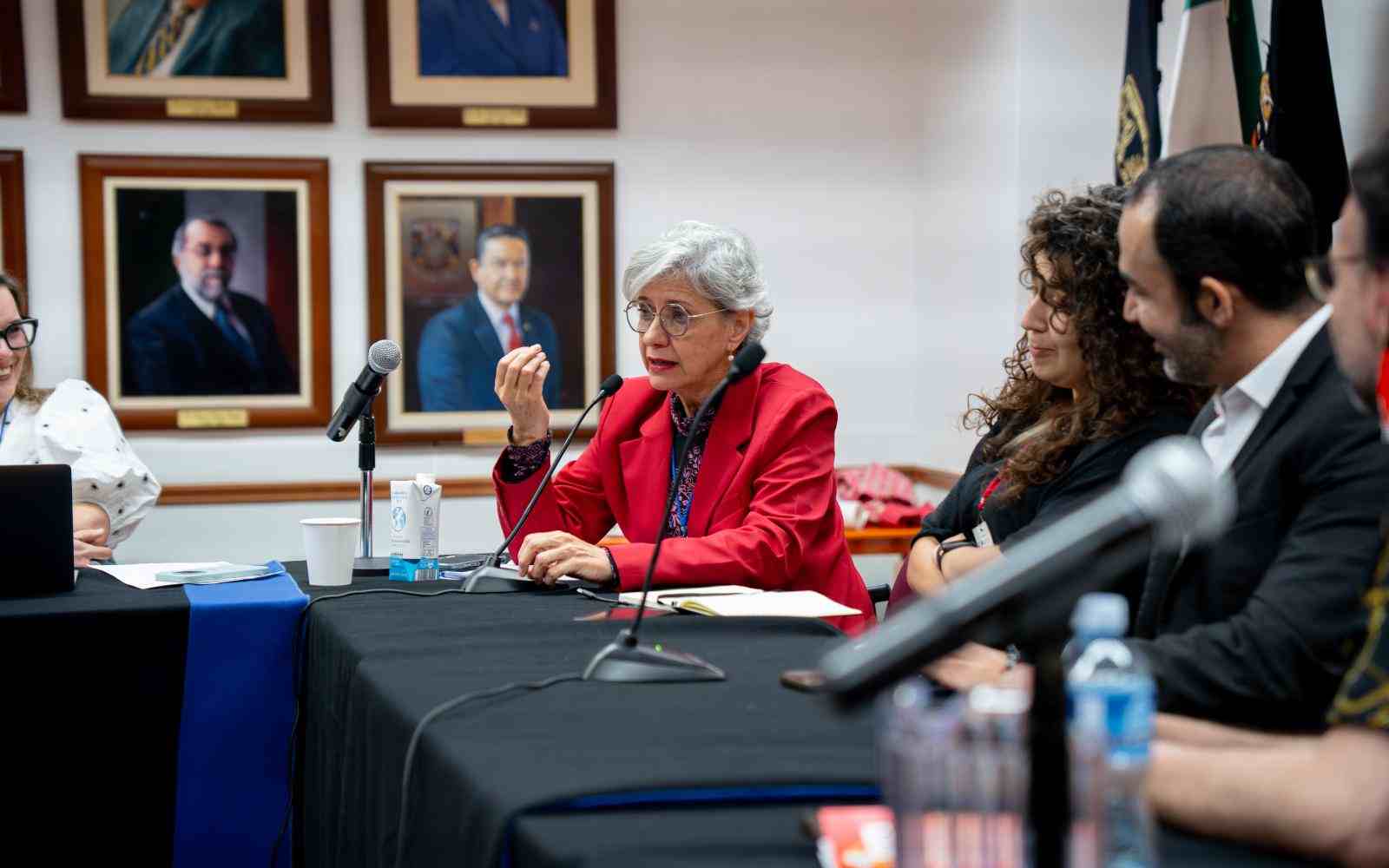
This shift in dynamics has brought with it a certain paradigm of “protection” which, while necessary, is insufficient. Migrant women are a prime example of agency throughout the region. This was the topic of discussion at the Gender and Migration panel held during the Hola América Festival, which took place in Mexico City on November 5 and 6, 2025. Entrepreneurs, advocates, and activists from across the region explored the need for new perspectives.
At the intersection of gender and migration, risk, precarity, and exclusion emerge. But these realities don't tell the whole story. There are concrete and urgent forms of violence—trafficking, forced displacement due to gender identity, health or documentation barriers—that demand a response. Ignoring them would be irresponsible. But when the public narrative focuses exclusively on these issues and turns protection into an automatic response, the horizon narrows. Protection saves lives, yes, but if it becomes the sole framework for action, it can lead to paternalism or the substitution of decisions.
Therefore, the fundamental question is not only how we best respond, but from what perspective we look to do so.
Change rules, don't just follow cases
Miriam González Sánchez, a collaborator with the Institute for Women in Migration (IMUMI) in Mexico—an organization that promotes the rights of migrant women and their families—explains: “ It’s not enough to simply provide support: we have to change the rules.” This shift is key. If policies are limited to addressing individual emergencies, the conditions that produce exclusion remain unchanged.
As Mariana de la Cruz of Casa Frida Refugio LGBTIQ+ —an organization dedicated to the protection, support, and social integration of LGBTIQ+ people who are victims and survivors of extreme violence, crimes, and hate crimes in Mexico—warns , “inequalities don’t disappear when we cross a geographical border.” Nor does agency. Crossing a border reconfigures power relations, but it doesn’t erase them. Therefore, more than simply reinforcing protection mechanisms, the challenge lies in examining which norms, procedures, and logics are generating recurring exclusions.
In healthcare, incorporating gender and diversity variables into records is not merely symbolic; it acknowledges realities that are otherwise excluded from institutional design. In education, for example, many obstacles stem not from ill will but from administrative requirements designed for stable educational pathways. Modifying these requirements expands rights in a more lasting and structural way than any isolated exception. In the economic sphere, promoting financial autonomy and co-production with migrant communities shifts the focus from assistance to shared responsibility.
Along the same lines, Jorge López, founder of the Vibremos Positivo initiative and Development Officer at AID for AIDS Mexico —an organization that addresses the challenges and opportunities faced by LGBT+ migrants in accessing comprehensive healthcare, including HIV, mental health, and discrimination-free care—reminds us that for many LGBTIQ+ people, migration is not an economic or professional decision, but a survival strategy. When displacement stems from the need to protect one's life or identity, the conversation about protection takes on a different dimension: it's not just about providing assistance, but about guaranteeing structural conditions of dignity.
Empathy without appropriation
“If you try to put yourself in someone else’s shoes, there’s no room for them.”
Besides the rules, how we relate to each other also matters. Another tension runs through public discourse: empathy understood as substitution. “If you try to put yourself in someone else’s shoes, the other person is left without a place,” warns de la Cruz. In the name of empathy, we sometimes believe we are giving these people a voice and translating their experiences into categories that are comfortable for us, deciding what is best for them.
Recognizing without replacing implies accepting the distance and enabling spaces where the voice and the decision are not permanently mediated.
Manu Mireles , a non-binary trans woman and migrant from Venezuela living in Argentina, who works as an activist and consultant in Diversity, Equity, and Inclusion, puts it in profoundly human terms: “ If we cannot see ourselves in people’s eyes and listen to each other, we distance ourselves from humanity.” Empathy then ceases to be total identification and becomes a practice of listening without taking the other person’s place.
When the narrative focuses solely on vulnerability, the response tends to be paternalistic. When the capacity for action is also acknowledged, the scenario changes. People in motion cease to be objects of guardianship and intervention and are instead recognized as agents of change.
Learning to live in diversity
For Carolina Nieto, Ashoka Fellow and former director of Ashoka Mexico, Central America and the Caribbean , the intersection of gender and migration can be summarized in a demanding idea: “learning to live in diversity. Not as a friendly slogan, but as a profound review of how we distribute power.”
Formal equality does not guarantee horizontal relationships. Legal recognition does not eliminate everyday hierarchies. If migration forces us to rethink belonging and borders, gender invites us to examine power and relationships.
This March 8th can be a moment to re-examine these frameworks and ask ourselves which structures and narratives continue to reproduce inequality; because protection is necessary, but insufficient. Recognizing that broadening the conversation to include agency, power, and freedom is not naive optimism: it is a condition for equality to cease being a promise and become a reality.