The Ecosystem Accelerator Methodology Toolkit
The Ecosystem Accelerator addresses complex issues by promoting collaborative solutions. With a focus on the field of migration, it aims to break down silos, foster collaboration, and counteract strategies harming People on the Move and those welcoming them.
At Hello World, we leverage the Ecosystem Accelerator, a focused strategy that brings together change leaders from various stakeholder groups to tackle sector-specific challenges. Drawing on over 40 years of Ashoka's experience in nurturing social entrepreneurship, we implement proven methodologies within entire ecosystems to promote collaborative innovation.
We also developed more detailed tools and guides for partners that wish to carry out accelerators, for more information, reach out to [email protected].

The Ecosystem Accelerator Guide
This guide is designed for people and organisations that are wanting to support or attract citizen-sector solutions to grow. If you have already decided to launch an accelerator, this can help you design it. If you are looking for how best to scale initiatives, this can provide insights and models to help. If you are a social entrepreneur wanting to scale your initiative abroad, this could give you insights on the kind of things you need to think about and the support you need to get. Finally, if you are a funder, or wanting to support this work, this can help you better understand the process and the keys to success for the initiative you are considering supporting.
Hello Europe has also developed more detailed tools and guides for partners that wish to carry out accelerators, for more information, reach out to [email protected].

Hello Europe Impact Evaluation Report 2020
REPORT & FACT-SHEET
Our 2020 Impact Evaluation Report shows Hello Europe’s work and impact from its inception. Due to the Covid-19 pandemic, some of our key Policy work was delayed until late 2020-early 2021: our report on this work is displayed in the “Policy Report 2021” appendix. You can see a quick overview of our policy impact in the Fact-Sheet.

Branding Guide for Migration
The porCausa Foundation has worked on the migratory narrative since 2016. They analyze its creation, its characteristics, and how it infiltrated public opinion, most importantly, in large audiences and public debates.
The migration narrative on securitisation was generated with the purpose of creating fear in citizens and proposes that the primary solution should be to increase resources to control and limit the movement of people around the world. This primitive narrative has grown and evolved until now in which the topic of migration has become a tool to support carefully crafted nationalistic and protectionist debates. Today, it is generally accepted to twist the framework on the true migratory narrative. This guide presents the conclusions on a variety of projects in this field and gathers the information of a vast number of social studies, campaigns, and personal experiences.
Their conclusions are summarised in three rules to create content and four additional tools that permit better quality of the message and its absorption.

Narrative Webinar in Partnership with PorCausa
The webinar helped participants understand the new narrative paradigm of migration which has been composed by a mixture of fear and digital media, and help them to instead create a more useful narrative framework. The session begin with an introductory section including a look at the history of how we arrived here, analysing the changes in communication and media in the last 20 years. The second and main section shared with participants critical rules and the tools to create a new narrative framework that can be used to convey information in any imaginable form, from online media to radio, from storytelling to an advocacy campaign. The webinar was designed to equip participants with the tools to confidently position their work and tell their story.
Recorded on Feb 10th, 2020

Lobbying Webinar in partnership with The Good Lobby
The intension of this webinar was to inspire participants to embrace a strategic and hands-on understanding of lobbying as a legitimate and effective approach to pursue their organisation’s mission. It focused on the various advocacy channels and participatory opportunities available to social entrepreneurs and organisations in a world increasingly defined by new power structures. The ultimate aim was to offer insights and practical tools needed to create compelling, evidence-based, legally compliant and solution-driven-campaigns. Finally, the webinar elaborated on a few examples of how lobbying tools can serve the purpose of social entrepreneurs drawing insights from concrete examples and case studies.
Recorded on Dec 2nd, 2019

Welcoming Standards
The Welcoming Standards outline the core of what it means for a community to be welcoming and set out the smart local policies, programs, and partnerships that give communities the welcoming edge. It serves as the backbone of the Certified Welcoming program — a formal recognition for city and county governments that meet the rigorous requirements of the Welcoming Standard.
In Australia, the Standard is organized into six categories to building a welcoming community: Leadership, Social and Cultural Inclusion, Economic Development, Learning and Skills Development, Civic Participation, and Places and Spaces.
In the United States, the Standard is organized into seven categories critical to building a welcoming community: Government Leadership, Equitable Access, Civic Engagement, Connected Communities, Education, Economic Development, and Safe Communities.
In Germany, the Indicator is organized into action areas including management and control, fair access and opportunities for participation, labor and economic development, intercultural openness and anti-racism, engagement and participation, solidarity, and communication and conflict management.
In New Zealand, the Standard is organized into eight elements: Inclusive Leadership, Welcoming Communications, Equitable Access, Connected and Inclusive Communities, Economic Development, Business and Employment, Civic Engagement and Participation, Welcoming Public Spaces, and Culture and Identity.

Esade & Ashoka Hello Europe Paper
A ground-breaking paper on social entrepreneurs from a migrant background titled “Humans at the center: How social entrepreneurs of a migrant background are making a difference” co-authored by Asma Naimi, PhD candidate at ESADE, Lisa Hehenberger, Director of ESADE’s Entrepreneurship Institute and Assistant Professor of Strategy and General Management, and Kenny Clewett, Executive Director of Hello Europe. It is a practical report centered on social entrepreneurs from a migrant background, showing their unique characteristics, approach, and advantages to create opportunities for and serve communities of migrants. The paper also outlines practical recommendations to support their work from different sectors (business, government, etc.). This paper is fruit of a collaboration between Ashoka Hello Europe and ESADE’s Entrepreneurship Institute.

Economic Implications for Migration Report
PorCausa Foundation has also released two reports focused on the Migration Control Industry. The first report titled "Who takes the money?" considers who benefits from the flows of these funds and who advocates for their interest and lobbies for them. The second report titled “Who are the paymasters?” alludes to the policies and funds that are aimed at migration control beyond the EU’s borders, or the EU’s externalization policy, as well as who is managing irregular and regular migration internally.
Gonzalo Fanjul, Ashoka Fellow and Hellopreneur, and his team at PorCausa Foundation have published a timely and much-needed report in Spanish in collaboration with Universidad Carlos III de Madrid on the state of irregular migrants in Spain. This is the first report of its kind on this type of migration to be released in years. It is estimated that there are between 390,000 to 470,000 irregular migrants in Spain – around 0.8% of the non-EU population – who are mostly from Latin America with significantly less being from Africa. The report explores the social and economic reality of irregular migrants in Spain pointing to massive advantages in regularizing migrants.

Local inclusion action tool (LIAT)
A helpful tool to identify what works for migrant and refugee inclusion and how to measure it, especially aimed at cities and municipalities. The Local Inclusion Action Tool, developed by OECD, Migration Policy Group, Welcoming International and Intercultural Cities/Council of Europe, is an attempt to distill the most up-to-date knowledge on what works in terms of migrant and refugee inclusion at the local level. The tool has been formulated with inclusion objectives to highlight common themes from the previously existing tools, making them action-oriented and adapted to vastly different contexts. The goal of the tool is to offer local policy makers, and other practitioners working at the local level, an action-oriented approach to advancing migrant and refugee inclusion in their communities.

Portfolio of Solutions
Hellotrepreneurs have proven, impactful solutions around migration in areas such as labor market integration, education, intercultural dialogue, housing and health. Often, these social entrepreneurs have found solutions that could be readily applied in many other countries instead of reinventing the wheel elsewhere.
For more than three decades Ashoka has developed and refined many platforms and methodologies to support social entrepreneurs to exponentially scale their impact. The Ecosystem Accelerator brings together a collection of these tools in a 3 stage process which aims to cultivate demand and strategy for proven solutions around migration and integration to flourish in specific national and local context.
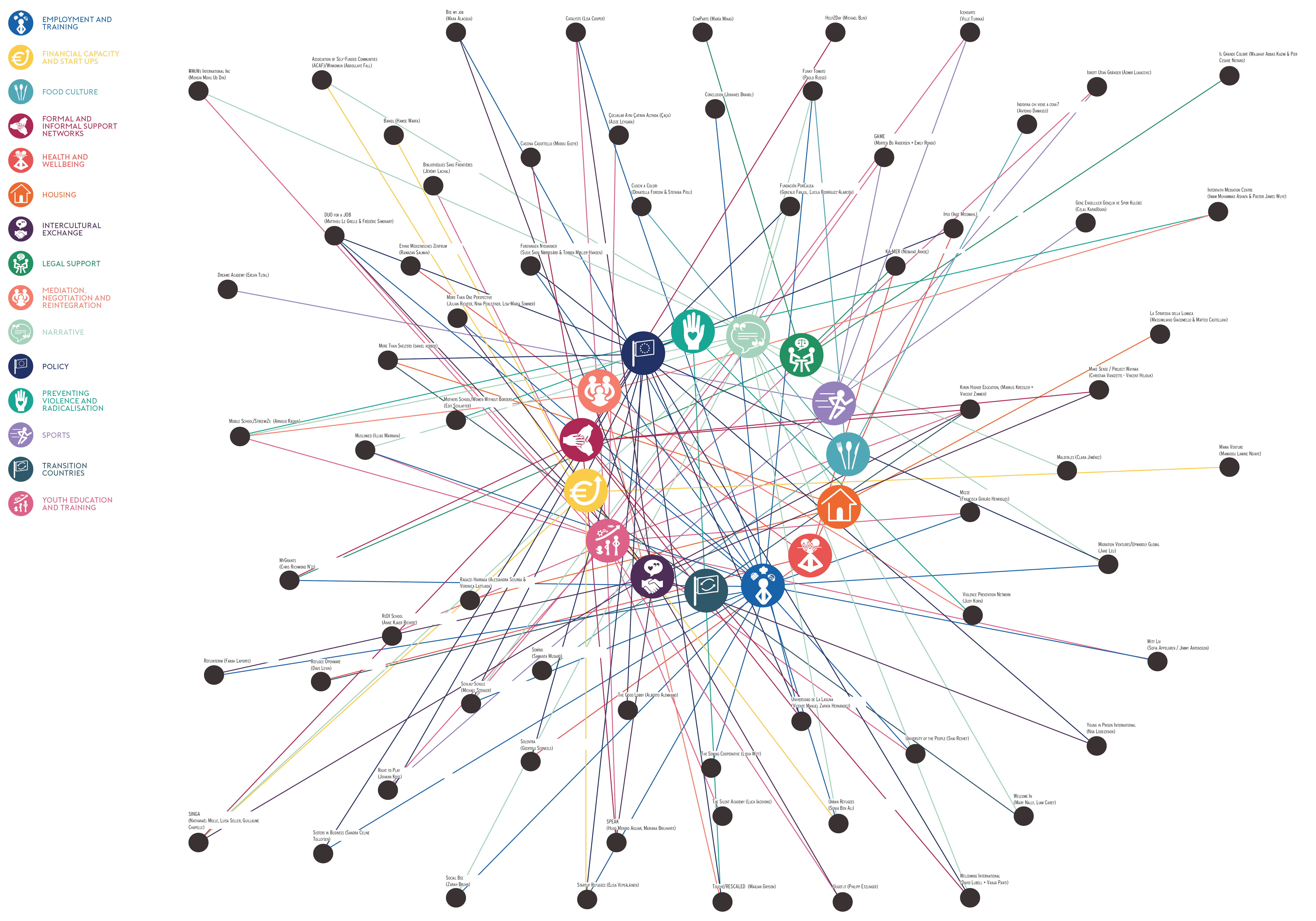
The Ecosystem Accelerators have taken place in 10 regions spanning 12 countries including Germany, Austria, Turkey, the Netherlands, Belgium, Spain, Italy, Portugal, Greece and the Nordics (Sweden, Norway and Denmark) with Poland launching in late 2019.
To date, 83 individual social innovations have been selected and directly supported through the accelerator and support structures.
HELLO EUROPE’S FIRST PORTFOLIO OF SOLUTIONS
Developed for the first EU Migration Policy Summit in 2018, Hello Europe’s first Portfolio of Solutions describes how Accelerators work, some key principles, and lists a number of the first Hello Europe Solutions that have scaled throughout Europe.